 Brilliant Waves
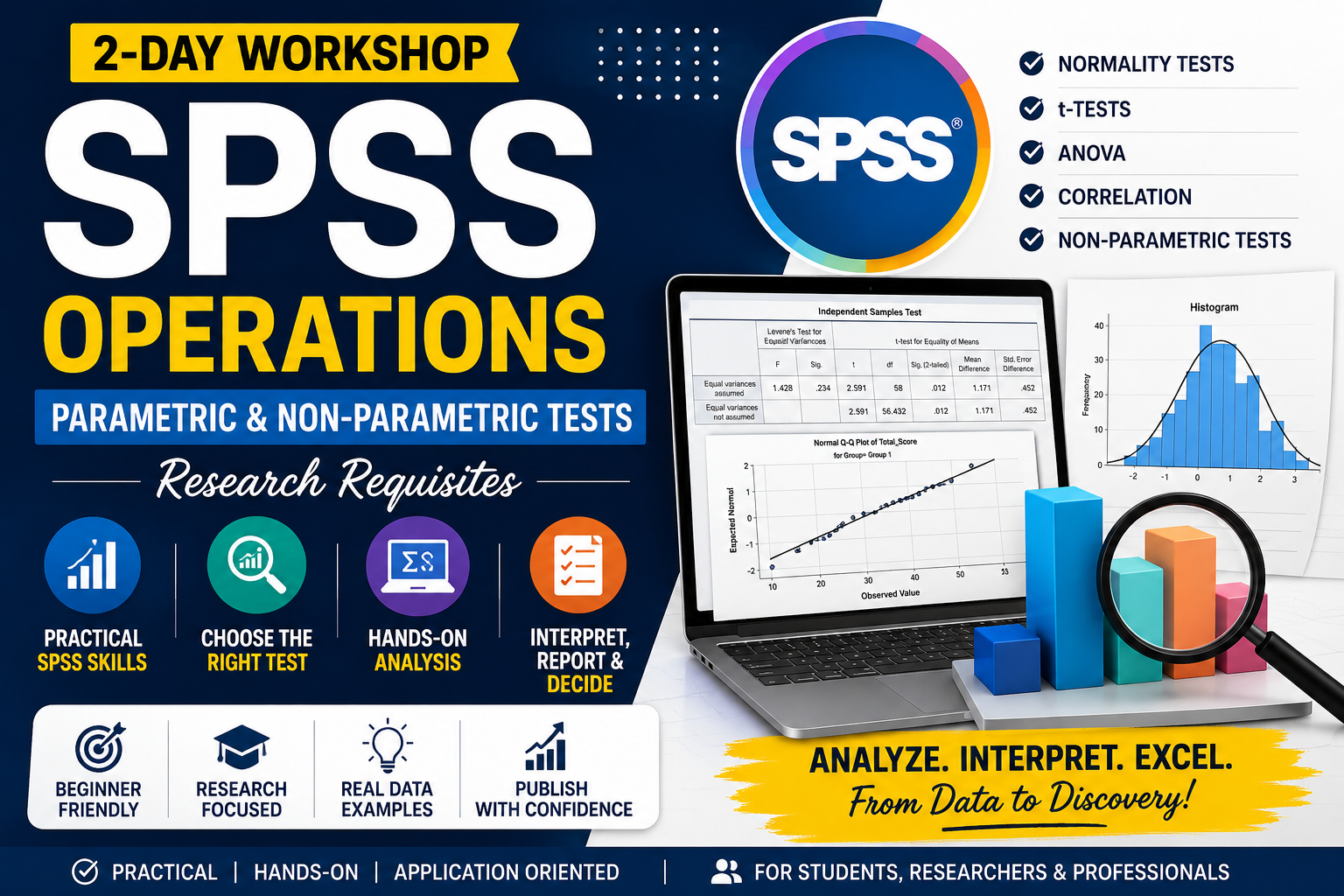
2-Day Workshop on SPSS Operations: Parametric and Non-Parametric Tests (Research Requisites)
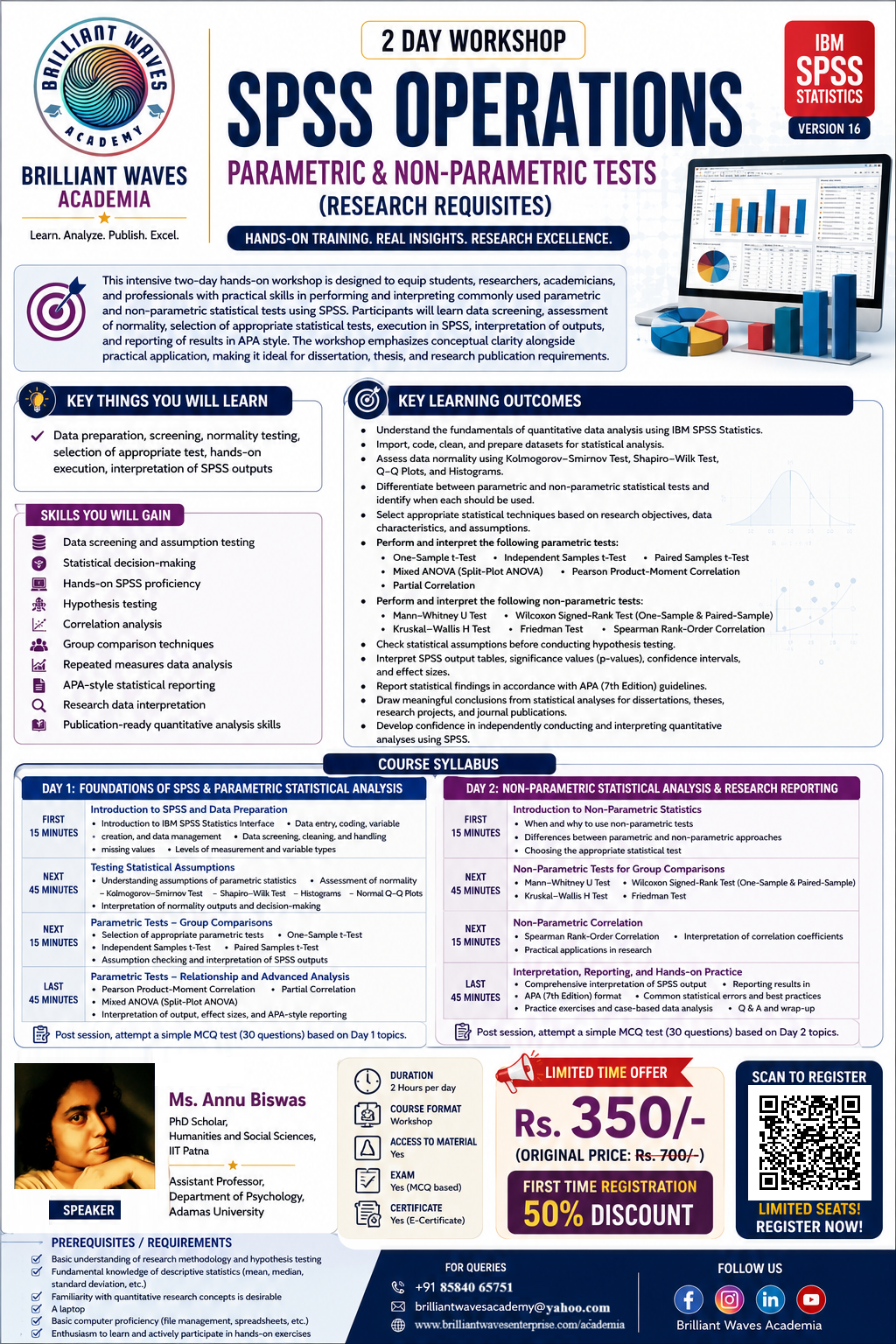
Statistical analysis forms the backbone of quantitative research, and selecting the appropriate statistical technique is essential for producing valid, reliable, and publishable research findings. This comprehensive two-day workshop is designed to provide participants with practical expertise in conducting and interpreting both parametric and non-parametric statistical analyses using IBM SPSS Statistics, Version 16.
The workshop adopts a hands-on, application-oriented approach where participants will work directly with datasets in SPSS while simultaneously understanding the theoretical rationale behind each statistical procedure. Beginning with data screening and assessment of statistical assumptions, participants will learn how to evaluate normality through graphical and statistical techniques before selecting the appropriate analytical method.
The workshop will cover methods for testing normality, including the Kolmogorov–Smirnov Test, Shapiro–Wilk Test, Q–Q Plots, and Histograms, enabling participants to determine whether parametric or non-parametric analyses are appropriate for their data.
The parametric statistics module will include:
- One-Sample t-Test
- Independent Samples t-Test
- Paired Samples t-Test
- Mixed ANOVA (Split-Plot ANOVA)
- Pearson Product-Moment Correlation
- Partial Correlation
The non-parametric statistics module will include:
- Mann–Whitney U Test
- Wilcoxon Signed-Rank Test (One-Sample and Paired-Sample Applications)
- Kruskal–Wallis H Test
- Friedman Test
- Spearman Rank-Order Correlation
In addition to performing these analyses in SPSS, participants will learn:
- Choosing the appropriate statistical test based on research objectives and data characteristics
- Understanding assumptions underlying statistical tests
- Running analyses efficiently using SPSS
- Interpreting SPSS output tables accurately
- Reporting statistical findings in APA style
- Understanding effect sizes and practical significance where applicable
- Avoiding common statistical and interpretation errors in research
The workshop is particularly suitable for undergraduate and postgraduate students, doctoral scholars, faculty members, research professionals, clinicians, and individuals engaged in quantitative research across psychology, social sciences, management, education, health sciences, and related disciplines.
By the end of the workshop, participants will have developed the confidence to independently conduct, interpret, and report a range of commonly used statistical analyses using SPSS, thereby strengthening the methodological quality of dissertations, theses, journal articles, and research projects.
Learning Outcomes
Upon successful completion of the workshop, participants will be able to:
- Assess data normality using both statistical tests and graphical methods.
- Distinguish between parametric and non-parametric statistical techniques.
- Select appropriate statistical analyses based on research design and assumptions.
- Conduct parametric and non-parametric tests using IBM SPSS Statistics.
- Interpret statistical outputs accurately and draw meaningful conclusions.
- Report statistical analyses according to APA guidelines.
- Apply statistical decision-making confidently in academic and professional research.
This workshop is designed to bridge the gap between statistical theory and practical application, ensuring that participants not only know which test to use, but also why it is appropriate, how to perform it correctly in SPSS, and how to communicate the findings effectively in scientific research.